

Table Of Contents
They say that dogs are a man’s best friend, but the bond that we can form with our horses can be just as strong, if not stronger.
Keeping your horse happy and healthy as they age means paying special attention to how their horse diet needs to change for each stage in their life.
Like us, as horses age, their muscles and joints begin to stiffen, making movement more challenging than it was before. If you’re over 30 and try to get off the couch after watching a long movie, you know what we mean.
Basically, when your horse is considered a “senior”, which is usually around 20 years of age, they just won’t be running and jumping like they used to.
As you can imagine, old horses also have a tougher time dealing with joint conditions like laminitis, ringbone, and arthritis—conditions that can occur in horses of any age, but are exacerbated by the natural aging process.
Joint health conditions in older horses are not exactly uncommon. For instance, evidence shows that the prevalence of osteoarthritis in horses older than 15 years is greater than 50%, with that number increasing to 80–90% when they reach over 30 years old.
But don’t assume that just because a horse is older that it can’t still be active or be able to get relief from chronic joint conditions. Aside from ensuring that your senior horse’s core nutritional needs are met and that routine healthcare checks are always up-to-date, an easy and effective way to maintain your horse’s joint health as they age is to feed them senior horse joint supplements.
Horse supplements help your horse feel more comfortable as they age by giving their bodies more essential nutrients and ingredients to maintain overall health.
In this article, we’ll outline the benefits and considerations for choosing senior horse supplements and give you some recommendations.
What Causes Joint Mobility Issues in Older Horses?

Joint mobility problems in senior horses can be caused by a wide range of factors, including environmental, nutritional, genetics, and health conditions they experience over their lifetime.
1. Wear and Tear on the Joints from Performance and Work
Sport horses generally experience more joint health issues than leisure horses because they are always pushing themselves to the limit of their abilities.
In one 2008 study, 850 Polish thoroughbred horses were long yearlings (late fall of the year following their birth) and followed until they were two years old, and were examined regularly for joint problems. The study results showed that the 850 horses sustained 861 injuries that affected their muscles, ligaments, or tendons, with arthritis being the most common problem. It’s important to note that the horses were examined for any joint problems prior to the study occurring, and did not show any issues. The study doesn’t indicate whether the horses were given joint supplements at any point, but it’s unlikely. What is likely, however, is that these horses have joint problems today as seniors.
2. Poor Diet
Glucosamine is one of the most important nutrients for joints, as it helps your horse develop:
-
Glycosaminoglycans (GAGs) and proteoglycans, help with lubrication and shock absorption in your horse’s joints.
-
Protein is also needed to develop proteoglycans and collagen, the latter of which helps maintain the integrity of cartilage.
-
Other important components that are needed in your horse’s diet for good joint health include amino acids, omega-3 fatty acids, calcium, phosphorus, and more. Typically, they’ll get all these nutrients from good-quality forage and compound feed.
However, it’s important to remember that too much of a good thing leads to negative effects. For instance, horses that get fed too much protein can develop kidney problems. It’s important to follow the recommendations on feed and supplements to ensure your horse isn’t being fed more than they need.
3. Weight Issues
Extra weight on your horse puts extra stress and pressure on their joints, potentially resulting in trauma and injury. This is especially true for senior horses that have degraded joint health due to age. Evaluating the body condition score of your horse is helpful for determining their ideal weight.
It’s important to remember that there is natural variability in weight due to breed and herd situation:
-
“Easy keepers” include draft breeds, ponies, quarter horses, and dominant horses in a herd.
-
“Hard keepers” include breeds like Arabian, thoroughbreds, and gaited horses, as well as the individuals that are lower in the pecking order of a herd.
A horse's body condition score (BCS) is evaluated by looking at different parts of the horse’s body, including the:
-
Neck
-
Withers (located at the top of the horse, at the base of the horse’s neck)
-
Back and loin (from the withers all the way along the horse’s back to their tail head)
-
Tail head (the base of their tail)
-
Ribs (underside or ‘belly’ of the horse near their front legs)
-
Behind the shoulder

Keeping these parts of your horse in mind, consider the following body condition score chart:
|
Condition Score |
Neck |
Withers |
Back & Loin |
Ribs & Shoulder |
Hind Quarters |
|
0 (Very thin) |
Bones are easily felt, no muscle where the neck meets the shoulder |
Bones are easily felt |
Can feel at least 3 vertebrae points |
Can feel each rib |
Tailhead and hop bones are protruding |
|
1 (Thin) |
Can still feel bones, but there’s slight muscle where the neck meets the shoulder |
Bones are easily felt |
Spinous process (long thin bones at the top of the back) can be easily felt, and the transverse process (muscles that attach to the spine) has a slight fat covering |
Some fat, but can still be felt |
Hip bones can easily be felt |
|
2 (Fair) |
Fat covering the neck |
Fat deposits over the withers (ideal levels depend on the horse’s conformation, or structure/shape) |
Fat over the spinous process |
Can’t see the ribs, but they can be felt |
Hip bones are covered with fat |
|
3 (Good) |
Neck flows smoothly into the shoulder |
Neck rounds out withers |
Back is level |
Layer of fat over ribs |
Can’t feel hip bones |
|
4 (Fat) |
Noticeable extra fat along neck |
Fat pads around withers |
Positive crease along back (fat is going along the back and on top of withers) |
Fat feels spongy and over and between ribs |
Can’t feel hip bones |
|
5 (Very fat) |
Bulging fat |
Bulging fat |
Deep positive crease |
Pockets of fat |
Pockets of fat |
The above chart can also be visualized via the following image:

If you have a herd of horses, changes in total feed, feed quality, seasons, and other factors can affect the BCS of a large number of individuals at a time. It’s recommended that you keep a chart that allows you to visually see potential changes in body condition for your herd as time passes (such as a line graph) as the typical BCS system geared towards individual horses.
4. General Joint Degradation
As horses age, they become more susceptible to joint-related illnesses and conditions. These conditions can happen naturally in your horse due to genetic factors but can also occur due to previous injuries, improper shoeing, and general trauma to horse muscles and ligaments.
Like human children, when your horse is young, chances are they’ll bounce back from a joint injury in no time with a little TLC. But as they age, recovery time can increase, and those injuries' potential lifelong negative effects can also heighten.
As a horse owner, you can do everything possible to prevent injuries to your horse’s muscles, ligaments, and joints, but sometimes injuries are just a part of life.
Given the prevalence of conditions like osteoarthritis in older horses, it makes sense that horse owners would seek a potential solution to help prevent this condition from forming in their senior horse or at least lessen its severity.
If you already have a senior horse that’s experiencing a joint-related condition, then it’s important to give them a senior horse joint supplement that has therapeutic levels of ingredients like glucosamine (sulfate and HCL) and chondroitin sulfate (these ingredients work together to promote new cartilage generation, and support muscles and ligaments), Methylsulfonylmethane (also known as MSM, a natural anti-inflammatory), and hyaluronic acid (promotes joint mobility).
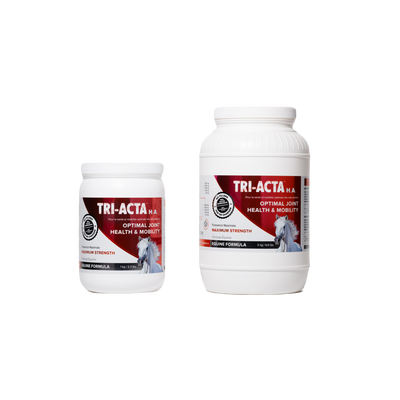
TRI-ACTA H.A. for equine is a senior horse joint supplement that has therapeutic levels of all of the above ingredients, with no fillers or additives.
Our maximum strength formula is perfect for horses that are ageing, experiencing arthritis and stiffness, are in training and competition, or under a heavy workload.
TRI-ACTA H.A. for Equine
Benefits of Senior Horse Joint Supplements
As horses age, years of activity can wear down cartilage, joint fluid, and connective tissue. Senior horse joint supplements help slow this decline, supporting comfort, flexibility, and lasting mobility so your horse can keep moving freely and feeling their best.
Senior Horse Joint Supplement Benefits Summary
|
Ingredient |
Function |
Key Benefit for Senior Horses |
|
Glucosamine (HCl & Sulfate) |
Rebuilds and protects cartilage |
Glucosamine HCl is highly bioavailable for faster absorption and pain relief, while glucosamine sulfate supports collagen production and helps reduce cartilage degradation. |
|
Chondroitin Sulfate |
Prevents cartilage breakdown |
Works alongside glucosamine to protect joint tissue, repair cartilage, and strengthen surrounding ligaments and muscles. |
|
MSM (Methylsulfonylmethane) |
Reduces pain and inflammation |
Acts as a natural anti-inflammatory, easing stiffness and soreness while supporting connective tissue and recovery. |
|
Hyaluronic Acid (HA) |
Improves joint lubrication |
Increases the viscosity of synovial fluid, enhancing joint cushioning and promoting smoother, more comfortable movement. |
Restoring Cartilage Health
Cartilage cushions your horse’s joints, but it naturally wears down over time, causing stiffness and discomfort. Glucosamine helps rebuild cartilage by supporting proteoglycan production—the foundation of joint tissue.
TRI-ACTA combines glucosamine HCl (highly bioavailable for faster absorption) and glucosamine sulfate (supports collagen production, a key structural component of cartilage). Together, they help repair damage and restore resilience, while research shows glucosamine reduces cartilage degradation in aging joints.
Preventing Cartilage Breakdown
While glucosamine rebuilds, chondroitin sulfate protects cartilage by blocking enzymes that cause deterioration. Working alongside glucosamine, it strengthens ligaments and muscles around the joint—boosting stability and elasticity to reduce strain and prevent reinjury.
Reducing Pain and Inflammation
Low-grade inflammation contributes to stiffness and soreness in senior horses. MSM (methylsulfonylmethane), a natural sulfur compound, provides anti-inflammatory and pain-relieving benefits. By easing swelling and improving circulation, MSM supports recovery and comfort, especially when paired with glucosamine and chondroitin.
Improving Joint Lubrication and Mobility
Healthy joints depend on synovial fluid, the lubricant that cushions movement. As horses age, their production of hyaluronic acid declines, reducing fluid viscosity. Supplementing with HA, as in TRI-ACTA H.A., helps restore lubrication, reduce friction, and promote smoother, easier motion.
Supporting Performance Longevity
Even senior horses can maintain comfort and mobility with consistent joint support. The combination of glucosamine (HCl + sulfate), chondroitin, MSM, and hyaluronic acid in TRI-ACTA H.A. addresses both the cause (cartilage wear) and symptoms (pain and stiffness) of joint decline—helping horses move freely, recover faster, and stay active longer.
What to Consider When Choosing Supplements for Senior Horses

Choosing the right supplement for your senior horse comes down to quality, concentration, and safety. Here’s what to look for:
Ingredient Quality and Purity
Joint supplements are not regulated in the United States and Canada, but that doesn’t mean you can’t make a good choice. In Canada, supplements can be approved as veterinary health products, provided the strict requirements are met. TRI-ACTA and TRI-ACTA H.A. for equine are both approved veterinary health products by Health Canada. In the US, the FDA labels animal supplements the same way as food, meaning that all ingredients must be listed and follow regulations, but there is some evidence to suggest that enforcement is limited. Be sure to read reviews and do research on the company before purchasing.
Therapeutic Dosage Levels
A wide variety of senior horse supplements on the market simply do not contain therapeutic levels of various ingredients. For example, one study suggests that an older horse should receive at least 10g (10,000mg) of glucosamine daily for therapeutic benefit. TRI-ACTA H.A. for equine contains 10,164mg of glucosamine.
Safety and Regulatory Standards
In Canada, joint supplements can receive VHP status if they meet strict Health Canada requirements for quality and labeling. Both TRI-ACTA and TRI-ACTA H.A. for Equine are approved VHPs. They’re also FEI legal for competition horses, meaning they contain no prohibited substances and are third-party lab tested for purity and safety. In the United States, supplements are classified as food by the FDA, which requires that all ingredients be listed—but enforcement is limited. Always read reviews and verify the company’s reputation before purchasing.
Life Stage and Condition Match
Senior horse supplements should match your horse’s specific needs. Therapeutic formulas like TRI-ACTA H.A. support aging or injured horses by maintaining cartilage integrity, reducing stiffness, and protecting joints from further wear. Consistent use helps maintain flexibility and comfort, even after years of training or performance.
Avoiding Controversial Ingredients
Some joint supplements use shark cartilage or other questionable sources for chondroitin. These ingredients raise environmental and ethical concerns due to the impact of shark harvesting on marine ecosystems. Integricare uses bovine-sourced chondroitin, ensuring a sustainable, ethical, and high-quality supply chain—without compromising efficacy or animal welfare.
Best Senior Horse Supplements
The best supplements for older horses that follow our considerations above include:
1. TRI-ACTA H.A. for Equine

When it comes to choosing the most cost-effective, reputable solution for protecting your senior horse’s joints, TRI-ACTA H.A. is a great choice. Because it contains only active ingredients, you only have to feed your horse 1 scoop (22g) per day after the initial loading dose of 2 scoops daily for 10 days. This means a 1kg container provides a 45-day supply for one horse. The senior horse supplement contains therapeutic doses of glucosamine, MSM, chondroitin, and hyaluronic acid and is an approved veterinary health product by Health Canada.
Starts at $129.99 CAD for a 1kg container. Pricing as of December 2025.
Our maximum strength formula is perfect for horses that are ageing, experiencing arthritis and stiffness, are in training and competition, or under a heavy workload.
TRI-ACTA H.A. for Equine
2. Purica Equine Recovery

Powdered senior horse supplements offer a myriad of benefits, but how does Purica stack up? In terms of therapeutic ingredients, it contains 10,000mg of glucosamine HCL, 10,000mg of MSM, and 100mg of hyaluronic acid. The dosage is relatively small (26g per day which can be reduced slightly after 30-60 days) even though it does contain some additional filler ingredients. However, this senior horse supplement is notably missing chondroitin, which works together with glucosamine to support the cartilage in your horse’s joints.
Starts at $99.95 for a 1kg bag. Pricing as of December 2025.
3. Kentucky Performance Products Joint Armour

This senior horse joint supplement contains similar ingredients to TRI-ACTA H.A., including glucosamine HCL and sulfate, chondroitin sulfate, and hyaluronic acid, but there are a couple of differences. First, the recommended serving is one 7g scoop, which contains 2,500mg of glucosamine HCL and sulfate respectively, 1,200mg of chondroitin sulfate, and 100mg of hyaluronic acid. The recommended serving size for the first two weeks is 14g or two scoops, which wouldn’t provide therapeutic amounts of the listed ingredients. After the initial two weeks, the serving is supposed to be reduced further to one 7g scoop. However, some reviews view the product favourably.
$103.99 CAD for a 1.16lb container. Pricing as of December 2025.
Summary
As your horse ages, it becomes increasingly important to maintain their joint health. Senior horse supplements can take an older lame horse from having a tough time moving around to gliding across the arena with no problem.
When choosing senior horse supplements, it’s important to research the company that made it to ensure that they are reputable and have good reviews, that the product has certification with Health Canada or another governing body, and that it has therapeutic levels of ingredients.
Get your senior horse started on TRI-ACTA H.A. today.
Our maximum strength formula is perfect for horses that are ageing, experiencing arthritis and stiffness, are in training and competition, or under a heavy workload.
TRI-ACTA H.A. for Equine
Share this post:



Proactive & Therapeutic Joint Supplements

When given daily, Integricare joint supplements recover bone and joint injuries faster and help prevent mobility injuries from happening in the first place.