

Table Of Contents
Whether you are watching your dog sprint after a frisbee or slowly climb onto the couch for a nap, it is easy to take their mobility for granted—until you notice a subtle limp or a familiar “bunny hop” in their stride. These small changes are often the first signs that something is happening beneath the surface. Understanding dog hind leg anatomy is one of the most effective ways to advocate for your dog’s long-term health and comfort.
Your dog’s rear legs act as the engine of their body. They generate the power and propulsion needed for everything from a casual walk to an explosive jump. Because they bear so much force and workload, the hind legs are often the first area to show signs of aging, joint strain, or sudden injury.
In this guide, we will break down the complexity and remove the medical jargon, offering a clear, pet-parent-friendly explanation of how your dog’s back legs work—and why keeping them healthy matters.
Key Takeaways
-
The power source: The hind legs act as the "rear-wheel drive" for your dog, providing the essential propulsion for running, jumping, and rising from a sitting position.
-
Unique bone structure: Dogs are digitigrade, meaning they walk on their toes (phalanges). Their ankle (the hock) is actually located much higher up the leg than a human ankle.
-
The "hinges" of mobility: Three main joints, the hip, stifle (knee), and hock, must work in perfect synchronization for a healthy, pain-free gait.
-
Muscle dynamics: The quadriceps (extensors) and hamstrings (flexors) work as a pulley system to fold and unfold the leg during movement.
Dog Hind Leg Anatomy: Functionality
To understand why your dog’s hind legs are so vital, it helps to think of them as a combination of a high-powered engine and a precision suspension system.
While the front legs are largely for steering and braking, the back legs are designed for raw power and structural integrity.
Here is how dog hind leg anatomy translates into the movements you see every day.
Locomotion and Propulsion
If your dog's body were a car, the hind legs would be the engine and the rear tires. They are the primary source of forward force in almost every type of movement.
-
Walking and trotting: During a normal walk, the hind legs work as propulsive levers. The cycle begins when the back paw makes contact with the ground. As the dog moves forward, the hip, stifle (knee), and hock (ankle) joints extend in a synchronized pushing motion. This leverages the ground to shove the dog's weight forward onto the front legs.
-
Running and sprinting: When your dog shifts into a gallop, the hind legs act like a coiled spring. The dog tucks their hind legs far forward under their belly, flexing the joints. The large muscles of the thigh (quadriceps and hamstrings) explode into action, straightening the legs and launching the entire body mass forward. This coiled energy is what gives dogs their incredible acceleration.
-
Jumping: Jumping is the ultimate test of hind leg strength. While the front legs provide the lift to get the head and shoulders up, the rear assembly is responsible for 100% of the forward and upward thrust. To clear a jump, a dog plants both rear feet and rapidly extends the hip, stifle, and hock simultaneously. This requires massive force, often several times the dog's own body weight, which is why hind leg injuries (like ACL tears) often happen during high-impact jumping.
Balance and Posture
While the hind legs provide the "go," they are also responsible for keeping your dog upright and steady during "transitions”—moments when they aren't moving in a straight line.
-
The tripod effect: When a dog turns a corner at high speed, the hind legs pivot to provide a stable base, preventing the rear end from sliding out.
-
Postural alignment: In a standing position, the hind legs are angled to create a wide, stable base. This "stacking" allows the dog to remain upright with minimal muscle effort. If you ever see a dog "roaching" (arching their back) or tucking their tail tightly, it’s often because they are struggling to find a comfortable balance point in their hind anatomy.
-
Changing elevations: When sitting or lying down, the hind legs act as the "lowering gear," controlled by the eccentric strength of the glutes and thighs to ensure a soft landing.
Weight Distribution
A common misconception is that dogs carry all their weight on their front legs. While the front does carry about 60% of the weight during a standstill, the hind legs take over the heavy lifting during activity.
-
Force transmission: Every time your dog’s back paws hit the ground, a "ground reaction force" travels up the leg. The anatomy of the hind limb is uniquely designed to absorb this shock through the angles of the joints.
-
Shifting the load: If a dog is injured in a front paw, they will shift nearly all their weight to the hindquarters. Conversely, if a dog has hip issues, you’ll notice them leaning forward to take the pressure off the back—this "weight shifting" is one of the first signs of orthopedic discomfort.
-
The pelvic link: Unlike the front legs (which are attached to the body by muscle and tendon), the hind legs are physically "locked" into the skeleton at the hip socket. This direct bone-on-bone connection is why force is transmitted so efficiently from the legs to the rest of the body.
Skeletal Structure of the Hind Limbs in Dogs
To truly understand how your dog moves, jumps, and plays, you have to look at the bone structure in dog hind leg anatomy. Think of this skeletal framework as the chassis of a car. It provides the rigid support and specific angles necessary for the "engine" (the muscles) to drive the body forward.
The anatomy of a dog's hind leg is built on a series of specialized bones and high-pressure joints that work in perfect harmony.

|
Body Region |
Structure |
What It Does |
|
Pelvic Girdle |
Os Coxae (Ilium, Ischium, Pubis) |
The foundation that connects the spine to the legs. It houses the acetabulum (hip socket) and provides attachment points for major power muscles, such as the gluteals and hamstrings. |
|
Upper Leg |
Femur (Thigh Bone) |
The strongest bone in the body. It articulates with the pelvis to form the hip joint and transmits power from the rear assembly to the rest of the body. |
|
Knee Region |
Patella (Kneecap) |
A small bone sitting in the femoral groove. It acts as a pulley for the quadriceps, allowing for efficient leg extension and jumping power. |
|
Lower Leg |
Tibia & Fibula |
The tibia (shin bone) bears the weight, while the fibula acts as a stabilizer and an anchor for lower leg muscles. |
|
Foot & Toes |
Tarsals, Metatarsals & Phalanges |
The foot structure. Because dogs are digitigrade, they walk on their phalanges (toes), while the tarsals (hock) sit high off the ground. |
|
Key Joint |
Hip Joint |
A high-motion ball-and-socket joint. Its health is critical for a full range of motion; issues here often lead to hip dysplasia. |
|
Key Joint |
Stifle Joint (Knee) |
The complex hinge between the femur and tibia. In dogs, this joint is always slightly bent, putting constant tension on the dog hind leg anatomy ligaments like the CCL. |
|
Key Joint |
Hock Joint (Ankle) |
The sharp "point" on the back of the leg. It acts as a mechanical hinge that snaps back to provide the final "flick" of speed during a run. |
Dog Hind Leg Anatomy Muscle Structures

While the bones provide the framework, the anatomy of dog hind leg muscles and connective tissues is what transforms that skeleton into a powerful machine.
Understanding these soft tissues is key to recognizing why a dog might suddenly stop jumping or start bunny-hopping.
Muscles of the Thigh
The thigh is the engine room of the dog. Two massive muscle groups work in opposition to each other to create the push-pull motion of walking and running.
-
Quadriceps femoris: Located on the front of the thigh, these muscles are the primary "extensors." Their main job is to straighten the knee (stifle extension) and help pull the leg forward (hip flexion). If these are weak, a dog will struggle to stand up from a sitting position.
-
Hamstrings Group: Composed of three large muscles (biceps femoris, semitendinosus, and semimembranosus) on the back of the thigh. They do the heavy lifting of hip extension, providing the explosive power needed to propel the dog forward during a sprint.
Calf and Lower Leg Muscles
The muscles below the knee focus on stabilizing the foot and snapping the ankle for a final burst of speed.
-
Gastrocnemius (calf muscle): This is the large muscle on the back of the lower leg. It is the major engine for the hock, allowing the dog to push off the ground with force.
-
Digital flexors: These muscles run down to the toes. They are responsible for gripping the ground and providing stability when your dog is standing on uneven surfaces.
Functional Muscle Groups
In the anatomy of a dog hind leg, almost every movement is a conversation between these two functional groups.
-
Extensor muscles (the straighteners): These muscles increase the angle of a joint. They are the "push" muscles. For example, when your dog stands up from a nap, their quadriceps fire to extend the stifle (knee). Extensors are primarily responsible for bearing weight and providing the thrust to move the body forward.
-
Flexor muscles (the benders): These muscles decrease the angle of a joint. They are the "lift" muscles. When your dog picks up their back foot to take a step, the flexors contract to "fold" the leg so it doesn't drag on the ground.
During a normal walk or run, these groups coordinate in a specific rhythm:
-
The swing phase: The flexors contract to lift the leg and pull it forward.
-
The stance phase: As the paw hits the ground, the extensors take over, straightening the leg to shove the dog’s weight forward and support their mass against gravity.
Dog Hind Leg Anatomy Ligaments and Tendons
While muscles provide the power, dog hind leg anatomy ligaments and tendons provide the structural integrity.
Without these high-tension cables, the bones would slide out of place during those powerful muscular contractions.
Cruciate Ligaments (CCL)
The cranial cruciate ligament (CCL) is the most famous part of dog hind leg ligament anatomy. It sits inside the stifle (knee) and prevents the tibia from sliding forward relative to the femur.
Unlike humans, who usually hear a sudden "pop," when they tear their ACL, dogs often experience a slow fraying of the CCL (the equivalent of an ACL in dogs). If you notice your dog toe-touching or sitting with one leg tucked out to the side, this ligament is often the culprit.
Collateral Ligaments
These are the stabilizers on the sides of the knee and hock. They prevent the leg from buckling inward or outward. You can think of them as the side rails that keep the hinge of the joint moving in a straight line.
Achilles Tendon Complex
This is the thick, cord-like structure at the back of the hock (ankle). It is a combination of several anatomical regions of the dog's hind leg muscles (including the gastrocnemius) that merge into a single powerful attachment. It is vital for weight distribution.
If this tendon is damaged, a dog will walk "flat-footed" because they can no longer keep their hock elevated.
Common Dog Hind Leg Conditions and Injuries
Understanding dog hind leg anatomy is most helpful when it allows you to spot trouble before it becomes a serious mobility issue.
Because the hind limbs are the engine of the dog, injuries here can significantly impact their quality of life.
Here are the most common conditions pet parents should know:
Hip Dysplasia
Hip dysplasia is a developmental condition where the "ball and socket" of the hip joint doesn’t fit together perfectly. Instead of sliding smoothly, the bone rubs and grinds because the femur head is loose within the pelvic socket. This structural flaw leads to long-term wear, often resulting in gait changes, such as bunny hopping, where both back legs move together to minimize individual hip rotation.
Cruciate Ligament Injuries
The CCL is the most important part of dog hind leg ligament anatomy for stability, as it prevents the shin bone from sliding forward out from under the thigh bone.
While sudden "blowouts" happen during high-impact play, most dog CCL issues are caused by gradual wear and tear. A tell-tale sign is "toe-touching," where a dog barely lets their paw graze the ground.
Patellar Luxation
This occurs when the patella (kneecap) pops out of its groove in the femur, a common issue in smaller breeds. The dog hind leg anatomy ligaments holding the kneecap in place may be too loose, or the groove itself may be too shallow.
You might notice your dog "skipping" for a few steps and then suddenly kicking the leg out to "pop" the kneecap back into its proper alignment.
Muscle Strains and Sprains
Just like human athletes, dogs can suffer soft tissue damage. A strain refers to an injury to the dog hind leg anatomy muscles or tendons, while a dog leg sprain involves the ligaments.
These injuries typically manifest as localized heat, swelling, or tenderness when you gently palpate the thigh or calf area.
Arthritis and Degenerative Conditions
This is the "wear and tear" that often comes with age or as a secondary result of the conditions mentioned above.
The cartilage that cushions the joints wears down, leading to inflammation and the growth of bone spurs. You may notice your dog slowing down on walks or showing significant stiffness when first rising in the morning.
In more advanced or unmanaged cases, arthritis can also present as weakness or visible shaking in the back legs.
This trembling is not usually a neurological issue. It happens because painful joints inhibit normal muscle firing, forcing surrounding muscles to work harder to stabilize the hip, stifle, and hock.
Clinical studies on sarcopenia (age-related muscle wasting) show that orthopedic pain leads to disuse atrophy, which manifests as muscle tremors due to motor unit fatigue.
This further decreases joint support and creates a cycle of fatigue and instability.
Signs to Watch For
If you notice any of the following red flags, it’s time to consult your veterinarian for a closer look at your dog's hind leg bone structure and soft tissues:
|
What You Notice |
What it Looks Like |
What it Could Mean |
|
Limping or Lameness |
Any change in gait, bobbing of the head, or favoring one side. |
Acute injury, ligament strain, or early-onset arthritis. |
|
Muscle Wasting (Atrophy) |
One thigh looks thinner, "skinnier," or less muscular than the other. |
Chronic pain causing the dog to shift weight away from that leg. |
|
Reluctance to Move |
Hesitating before stairs, refusing to jump into the car, or slow to rise. |
General joint discomfort or "rear-end" weakness. |
|
Abnormal Sitting |
Sitting with one leg tucked or splayed to the side (the "Lazy Sit"). |
Difficulty or pain associated with fully bending the hip or stifle (knee) joint. |
|
Swelling |
Visible puffiness, "squishiness," or heat around the knee (stifle) or ankle (hock). |
Inflammation, fluid buildup, or a potential ligament tear, like the CCL. |
Not every change in movement means a serious injury, but these early signals are your cue to support your dog’s joints before small issues turn into long-term limitations. Alongside veterinary care, targeted joint nutrition plays a key role in maintaining comfort, mobility, and stability in the hind legs.
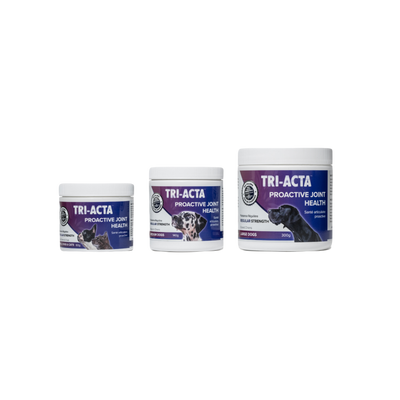
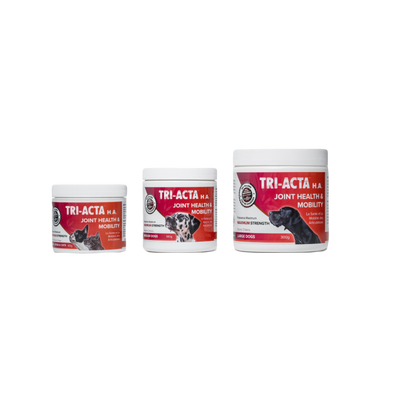
Dog joint supplements like TRI-ACTA and TRI-ACTA H.A. are formulated to support the structures most commonly affected in the rear legs, including cartilage, ligaments, and surrounding soft tissue.
By supplying key building blocks for joint health, nutritional support can help maintain comfort, preserve muscle use, and encourage more balanced movement as your dog ages or recovers from strain.
A proactive approach for developing and younger adult pets to maintain optimal joint health mobility, minimize inflammation and fend off age-related ailments.
TRI-ACTA for Pets
Development and Aging

As your dog transitions from a clumsy puppy to a graceful adult and eventually a dignified senior, the anatomy of their hind legs undergoes significant changes.
Supporting the structures of dog hind leg anatomy at each life stage requires a different approach to exercise, nutrition, and environmental care.
Puppy Skeletal Development
In the first year of life, a dog’s hind leg bone structure is not yet fully formed. Instead, it consists mainly of soft cartilage, especially at the ends of the long bones (the femur and tibia).
These areas of developing cartilage, known as growth plates or epiphyseal plates, are the engines of bone growth. Because they are soft, they are highly susceptible to injury.
High-impact jumping or repetitive, forced exercise (like long-distance running) while these plates are open can lead to permanent deformities or early-onset joint issues. Most growth plates in the hind legs close between 6 and 14 months of age, depending on the breed's size.
Adult Maintenance
Once the bone structure of a dog hind leg has fully matured, the focus shifts to protecting the joints by maintaining the surrounding soft tissue support system.
Strong dog hind leg anatomy muscles, particularly the quads and hamstrings, act as secondary stabilizers for the joints. If the muscles are lean and powerful, they take the "shock" out of every step, reducing the load on the ligaments and cartilage. Regular, varied exercise, such as swimming, walking on different terrains, and controlled play, keeps the tendons supple and prevents the stiffening that can lead to acute strains. This is the peak time to ensure your dog maintains an ideal weight. Even a few extra pounds can exponentially increase the wear and tear on the hip and stifle joints.
Senior Hind Leg Care
As a dog enters their senior years, the anatomy of dog hind leg muscles naturally begins to lose mass (atrophy), and the protective cartilage in the joints may thin.
Senior dogs often face a weakness cycle where discomfort leads to less movement, which in turn leads to muscle loss and further instability. Mobility support becomes crucial here. This might include using orthopedic beds to reduce pressure on the hips or placing rugs over hardwood floors to provide the "grip" that aging paws and weakened dog hind leg anatomy ligaments need to stay steady.
Gentle, low-impact movement remains vital to keep the joint fluid (synovial fluid) moving, which lubricates the hinges of the leg. For dogs with significant weakness, assistive devices like rear-end harnesses or ramps can help them navigate stairs and cars without putting excessive strain on their aging pelvic girdle.
Protecting Your Dog’s Rear Engine
Your dog's hind legs are far more than just a means of getting from point A to point B. They are a sophisticated system of bones, muscles, ligaments, and tendons working together to power every leap, turn, and cuddle session.
So, knowledge truly is power when it comes to your dog's mobility.
Although your dog can't tell you when something hurts, their body will. Pay attention to how they move, stay proactive about maintaining a healthy weight, and don't hesitate to consult your veterinarian.
One of the most effective ways to protect the intricate network of cartilage, ligaments, and synovial fluid in your dog's hind legs is through targeted joint support. Integricare's TRI-ACTA is formulated to nourish the exact structures we've discussed throughout this guide: the cartilage cushioning the hip and stifle joints, the ligaments stabilizing the knee, and the synovial fluid lubricating every hinge point from hip to hock.
Ready to boost your dog's joint health?
Purchase TRI-ACTA online or learn where to buy at a store near you.
Our maximum strength formula is optimally designed to accelerate the formation of cartilage, minimize inflammation, expedite the healing process, and improve joint conditions.
TRI-ACTA H.A. for Pets
Share this post:


Proactive & Therapeutic Joint Supplements

When given daily, Integricare joint supplements recover bone and joint injuries faster and help prevent mobility injuries from happening in the first place.